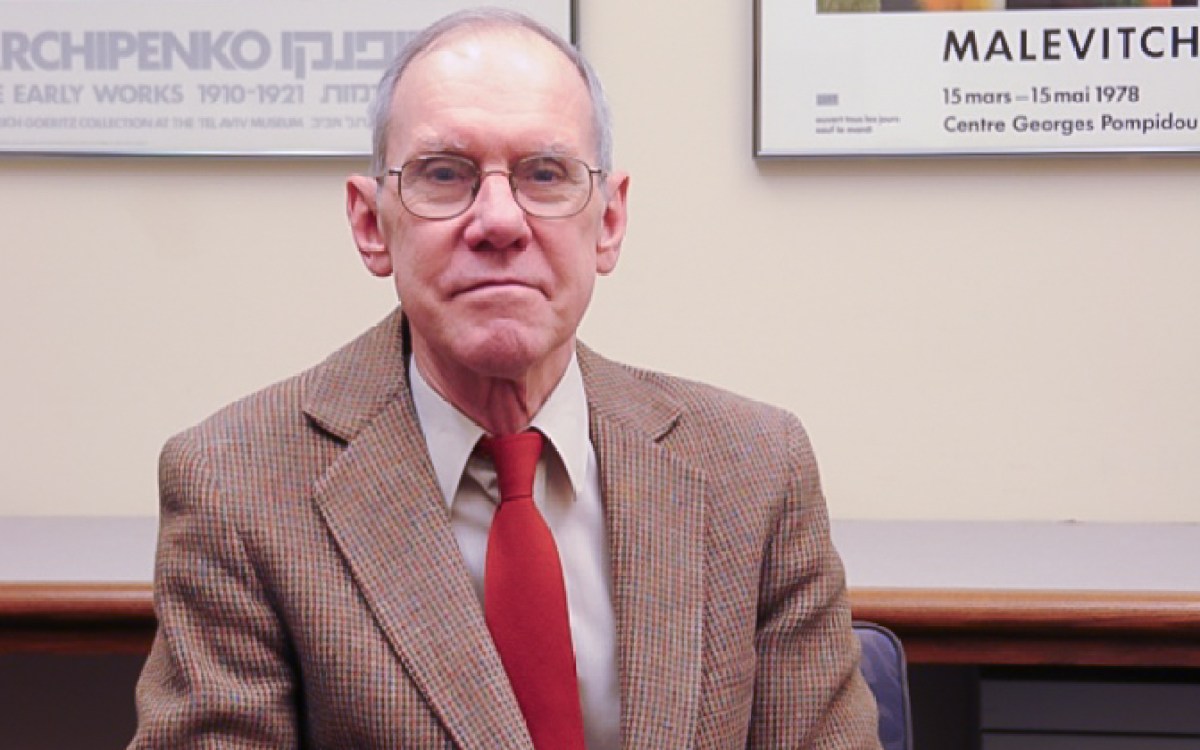
At a meeting of the Faculty of Arts and Sciences on Oct. 6, 2026, the following tribute to the life and service of the late John E. Malmstad was spread…
According to a recently published list of rankings for fiscal year 2003, the Forsyth Institute – a Harvard-affiliated nonprofit biomedical research organization – received more in federal grant funding from the National Institute of Dental and Craniofacial Research (NIDCR) than any university or other research organization in its specialty. With 40 principal investigators, the Forsyth Institute, unique among the funding recipients for being an independent research organization, was granted a total of $12,161,236 for its research in a variety of fields funded by NIDCR.
In recognition of their distinguished and continuing achievements in original research, five Harvard professors recently joined 67 other U.S. scientists and engineers to be elected members of the National Academy of Sciences (NAS). The election, which was held April 20 during the 141st annual meeting of the academy, brings the total number of active members to 1,949.
When Harvard University Professors Lawrence Bobo and Michael Dawson formally debuted the new peer-reviewed journal they are co-editing, Du Bois Review: Social Science Research on Race last month at the Organization of American Historians meeting, the reaction was not so much Why? as What took you so long?
Stem cell therapies have the potential to do for chronic diseases what antibiotics did for infectious diseases. It is going to take years of serious research to get there, but as a neurologist, I believe the prospect of a penicillin for Parkinsons is a potential breakthrough that we must pursue. As in other areas of creative endeavor in science, the answers will come only with careful experimentation.
While the new Harvard Stem Cell Institute aims to encourage scholarly examination of the ethical issues surrounding the institutes work, a Harvard committee has had a similar, but more practical, role for more than two years.
Seven Harvard schools, seven teaching hospitals, and close to 100 researchers and scientists are banding together in an ambitious new institute with a simple goal: to use stem cells to help the 150 million people nationally living with or dying from five types of organ and tissue failure.
Seven Harvard schools, seven Harvard-affiliated teaching hospitals, and close to 100 researchers and scientists are banding together in an ambitious new institute with a simple goal: to explore the promising area of stem cell research.
Stem cells are the fundamental source of all the bodys tissues, the template from which bodily cells are derived. As cells die off or are damaged, the hundreds of thousands of stem cells in the human body give rise – constantly – to new tissue. Injuries as simple as the scalding of the mouth with a hot beverage and as grave as the compromising of the immune system during chemotherapy require the activity of stem cells to repair cellular damage.
The reigning league champion Harvard mens tennis team inched closer to a repeat performance this past Saturday (April 17) with a not-so-slight 7-0 shutout of visiting Penn. Still perfect in league play, the Crimson (18-6, 4-0 Ivy) – who also downed Princeton, 5-2, a day earlier – next face Brown, also 18-6, 4-0 Ivy, this Friday (April 23) in Providence in a match-up that will likely have title implications.
Edward Elwyn Jones, currently acting University organist and choirmaster, has been appointed the seventh Gund University Organist and Choirmaster. The Rev. Professor Peter J. Gomes, Plummer Professor of Christian Morals and Pusey Minister in the Memorial Church, announced Jones appointment at the Easter morning service.
Last Friday evenings (April 16) presentation at Harvard Divinity School by the Rev. Dr. Mel White, the former dean of the largest gay and lesbian church in the world (the Dallas Cathedral of Hope), was billed as a lecture on Religion, Homosexuality and Marriage: Why We Cant Wait. But it was really a rallying cry.
Current thinking on how most communicable respiratory infections are spread – by large droplets over short distances or by coming in contact with contaminated surfaces (face-to-face) – needs to be reconsidered, according to Donald Milton, lecturer on occupational and environmental health at the Harvard School of Public Health and co-author of a perspective in the April 22 issue of the New England Journal of Medicine. The perspective coincides with the report by Yu et al. in this issue on airborne transmission of SARS.
The children who inhabit the world of award-winning author, educator, and activist Jonathan Kozol 58 dont wear designer clothing, dont have parents who drive around in SUVs, and dont vacation at Disney World. They live in extreme poverty in the inner cities in places like New York and Los Angeles and often endure chronic asthma, hunger, and homelessness as a way of life. For 40 years, Kozol has worked with these poor children, their parents, preachers, teachers, and principals – and spoken out against the inequities of this countrys public school systems.
Stem cell therapies have the potential to do for chronic diseases what antibiotics did for infectious diseases. It is going to take years of serious research to get there, but as a neurologist, I believe the prospect of a penicillin for Parkinsons is a potential breakthrough that we must pursue. As in other areas of creative endeavor in science, the answers will come only with careful experimentation.
Kofi Annan, the secretary-general of the United Nations and 2001 winner of the Nobel Peace Prize, will be Harvards 2004 Commencement speaker at the Afternoon Exercises on June 10.
At its 11th meeting of the year (April 14) the Faculty Council discussed with Dean of the College Benedict Gross (mathematics) and Professor Jennifer Leaning (faculty of public health) the implementation of the recommendations made last year by the Committee to Address Sexual Assault at Harvard (the Leaning Committee). Dean Julia Fox (Harvard College) and Susan Marine (director of the Office of Sexual Assault Prevention and Response) were present for this conversation.
April 4, 1907 – Nathan Marsh Pusey, Harvard’s future 24th President, is born in Council Bluffs, Iowa. April 15, 1912 – The luxury liner “Titanic” sinks in the North Atlantic.…
Following are some of the incidents reported to the Harvard University Police Department (HUPD) for the week ending April 10. The official log is located at 1033 Massachusetts Ave., sixth floor.
Marking the 50th anniversary of the landmark Brown v. Board of Education decision that desegregated Americas schools, Harvard Law School (HLS) turned its attention Tuesday night (April 13) to Justice of the United States Thurgood Marshall, who as legal director for the NAACP successfully argued the Brown case. Yet with a panel of eight HLS faculty members who clerked for Marshall, the event painted a far richer portrait of the civil rights leader than is well known. The panelists shaded his august jurisprudential legacy with personal recollections of Marshall as a boss and mentor who told salty stories, gambled with passion, and called his clerks knuckleheads.
Two music department faculty honored G. Gordon Watts Professor of Music Kay Kaufman Shelemay was elected fellow of the American Academy for Jewish Research. The academy represents the oldest organization…

 Featured series



 Gallery