
 Featured series

News+
-
News+
In Memorium: Vilma Hunt, former HSPH scientist, radiation expert, feminist
Vilma Hunt, a pioneering researcher who studied radioactivity in cigarette smoke and workplace environmental hazards for women, died on December 29, 2012. A former research associate and visiting scientist at Harvard School of Public Health (HSPH), Hunt was described in the January 3, 2012 Gloucester Times as one of Cape Ann’s “intellectual dynamos” and a “spitfire” who…
-
News+
Checklists in operating rooms improve performance during crises
In an airplane crisis—an engine failure, a fire—pilots pull out a checklist to help with their decision-making. But in an operating room crisis—massive bleeding, a patient’s heart stops—surgical teams don’t. Given the complexity of judgment and circumstances, standard practice is for teams to use memory alone. In a new study published in the January 17…
-
News+
Quirky video on adrenal glands wins Scientific American contest
A two-minute video written by Raluca Ellis, a postdoctoral fellow at the Harvard School of Engineering and Applied Sciences (SEAS), has won the Scientific American “Iron Egghead” video contest. The lively, quirky video explains the role of cortisol, adrenaline, and noradrenaline in the human body. The judges praised it for its humor, attention to detail,…
-
News+
The second term: Calestous Juma on international development
We spoke with Calestous Juma, professor of the practice of international development and director of the Science, Technology and Globalization Project, about the pressing international development policy issues of the president’s second term. Q: What are the top priorities for a second Obama administration in the area of international development? A: The international development scene underwent seismic changes during…
-
News+
Graphic warnings on cigarettes effective across demographic groups
Quitting smoking is a common New Year’s resolution for Americans each year, but research has repeatedly shown it is not an easy task. Some groups, such as racial/ethnic minorities, have an even harder time quitting. New research suggests hard-hitting graphic tobacco warnings may help smokers of diverse backgrounds who are struggling to quit. A new…
-
News+
Berries may lower women’s heart attack risk
A new study led by researchers from Harvard School of Public Health (HSPH) and the University of East Anglia finds that women who eat three or more servings of blueberries and strawberries each week may lower their risk of having a heart attack. The berries contain the dietary flavonoid anthocyanin, which may benefit the heart by…
-
News+
The second term: Robert Stavins on energy and environmental policy
We spoke with Robert Stavins, Albert Pratt Professor of Business and Government Environment and Natural Resources Program, about energy and environmental policy issues the president will face in the next four years. Q: What are the top priorities for a second Obama administration in energy and environmental policy? A: The Obama administration faces a number of impending challenges…
-
News+
HSPH experts help U.S. News rank top diets
The nation’s best overall diets for 2013, according to U.S. News & World Report, are the DASH diet, the TLC diet, and the Mayo Clinic diet. The magazine enlisted the help of 22 experts to make their choices, including two from Harvard School of Public Health (HSPH)—Teresa Fung, adjunct professor of nutrition; and JoAnn Manson, professor in…
-
News+
The second term: Robert Blendon on the Affordable Care Act
We spoke with Robert Blendon, professor of health policy and political analysis at the School of Public Health and faculty member of HKS, about the Affordable Care Act and its challenges on the president’s radar screen. Q: What health care policy priorities should be atop the president’s agenda in his second term? A: The election is now over…
-
News+
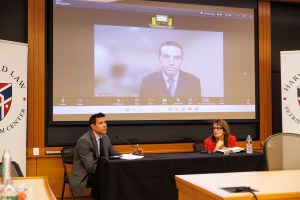
HLS symposium marks launch of global network of interdisciplinary centers
On Dec. 6-8, 2012, the Berkman Center for Internet & Society, together with seven international co-organizers, hosted a symposium at Harvard Law School titled “Internet-Driven Developments: Structural Changes and Tipping Points,” convening representatives from Internet and society research centers spanning 5 continents and 22 countries. At the event, led by the Berkman Center’s Executive Director Urs…
-
News+
Bebchuk, committee urge SEC to set corporate political spending rules
The Securities and Exchange Commission recently indicated in an entry in the Office of Management and Budget’s Unified Agenda that it plans to issue by April 2013 a Notice of Proposed Rulemaking on requiring public companies to disclose their spending on politics. The adoption of such a rule was urged in a rulemaking petition (PDF)…
-
News+
Six from Harvard Law School awarded Skadden Fellowships
Six students and recent alumni were recently were chosen by the Skadden Foundation to receive two-year fellowships to support their work in public service. This year’s recipients include current students Haben Girma ’13, Hunter Landerholm ’13, Adam Meyers ’13 and Mara Sacks ’13, and recent graduates Robert Hodgson ’12 and Daniel Saver ’12. The fellowships,…
-
News+
HKS deepens commitment to public policy research in China
Dean David Ellwood is leading a group of Harvard Kennedy School faculty members to Beijing to help strengthen the school’s commitment to the study of Chinese governance and public policy. The Harvard contingent will gather with a group of academics from throughout China at a week-long conference, “Challenge and Cooperation: How Can Rising China and Adjusting U.S.…
-
News+
New discussion paper addresses weapons challenges in the Middle East
Formidable challenges stand in the way of controlling and eventually eliminating nuclear, biological, and chemical weapons in the Middle East. A new discussion paper issued by the Project on Managing the Atom at Harvard Kennedy School’s Belfer Center for Science and International Affairs outlines both the challenges and a set of near-term measures designed to fast forward…
-
News+
HSPH to launch second public health course on edX
Harvard School of Public Health’s new online course, “Health in Numbers: Quantitative Methods in Clinical and Public Health Research,” an introduction to biostatistics and epidemiology, has drawn 53,857 students from all over the world. The three-month course, which began in October 2012, was one of the first two courses offered by Harvard through edX, the online…
-
News+
Consumers may need help navigating health insurance exchanges
Based on a 2010 survey of people who used Massachusetts’ health insurance exchange (“The Connector”) to sign up for a health plan—and who experienced some difficulty with things like understanding and choosing plans—a group of investigators concludes that such exchanges should be designed with users’ experience in mind. States are now required to create health…
-
News+
Breast cancer in China: HSPH to partner in new awareness initiative
Breast cancer is a leading cause of death among women in China, with 1.1 million new cases annually. China’s breast cancer mortality has doubled over the past 30 years. Diagnosis tends to be made when the women are older and already in Stage III/IV, compared to Western countries where patients generally are diagnosed earlier and…
-
News+
Comprehensive public health approach urged to curb gun violence in U.S.
In the wake of the horrific school shootings in Newtown, Conn., in December, three Harvard experts say the best way to curb gun violence in the U.S. is to take a broad public health approach, drawing on proven, evidence-based strategies that have successfully reduced other public health threats like smoking, car crashes, and accidental poisonings.…
-
News+
Counting the twists in a helical light beam
At a time when communication networks are scrambling for ways to transmit more data over limited bandwidth, a type of twisted light wave is gaining new attention. Called an optical vortex or vortex beam, this complex beam resembles a corkscrew, with waves that rotate as they travel. Now, applied physicists at the Harvard School of…
-
News+
Should young children use iPads?
Experts quoted in a December 17, 2012 Washington Post article—including Michael Rich, MPH ’97 and an associate professor in the Department of Society, Human Development, and Health at Harvard School of Public Health—raised doubts about the wisdom of allowing very young children to use iPads. Rich, who also directs the Center on Media and Child Health at Boston…
-
News+
Computer scientist Leslie Valiant named 2012 ACM Fellow
Leslie Valiant, T. Jefferson Coolidge Professor of Computer Science and Applied Mathematics at the Harvard School of Engineering and Applied Sciences, has been named a 2012 fellow of the Association for Computing Machinery (ACM). He is among 52 people who were recently named fellows for their contributions to computing that are fundamentally advancing technology in…
-
News+
Chinese breast cancer delegation visits HSPH
Breast cancer is a leading cause of death among women in China, with 1.1 million new cases annually. China’s breast cancer mortality has doubled over the past 30 years. Diagnosis tends to be made when the women are older and already in Stage III/IV, compared to Western countries where patients generally are diagnosed earlier and…
-
News+
Faculty articles garner acclaim
The McKinsey Quarterly has named articles by Harvard Business School professors Teresa Amabile and Cynthia Montgomery to its 2012 list of the journal’s 10 most popular articles. Amabile and co-author Steven Kramer were recognized, at number two, for “How Leaders Kill Meaning at Work,” an examination of how senior executives routinely undermine creativity, productivity, and…
-
News+
What’s killing the study of international relations
When it comes to international relations (IR), Robert and Renee Belfer Professor of International Affairs, Stephen Walt would suggest less testing and more conceiving. Walt and John Mearsheimer of the University of Chicago believe “downgrading theory and elevating hypothesis testing is a mistake,” when it comes to IR. The authors even call it “the road to ruin”…
-
News+
New findings on mercury contamination and seafood
Mercury released into the air and then deposited into oceans is increasingly contaminating seafood commonly eaten by people in the United States and globally, report scientists from Dartmouth College, Harvard School of Public Health (HSPH), and colleagues from other institutions in new research in the current issue of the journal Environmental Research and a companion report. The…
-
News+
Expanded sustainability offerings for 2013 Wintersession
This year, the partnership between the Office for Sustainability, the Office of Career Services, and Green Building Services will expand sustainability-focused offerings for students during Wintersession to include a full day of sustainable tours, and three days of shadowing experience. Students interested in Harvard’s Greenhouse Gas Reduction goal, energy auditing, green building, and other green…
-
News+
Home visits offer window into mother, infant well-being
A visit to homes of disadvantaged mothers and at-risk newborns can provide a health care team with unique insights into how a family is faring—more than might be revealed at often rushed visits at a clinic or hospital. This was one of the insights shared at the 7th Annual Maternal and Child Health Symposium, titled…
-
News+
Experts discuss similarities, differences between U.S., India health systems
It should come as no surprise that the health care systems of the United States and India differ in many ways, but what may be surprising is the amount they have in common. This fact—and what each country can learn from the other as it pursues improvements in health care—was the subject of a talk…
-
News+
Malaria parasite transforms itself to hide from human immune system
In order to spread disease inside the human body, the malaria parasite must evade the human immune system—which it does remarkably well. Now, researchers at Harvard School of Public Health (HSPH) have uncovered details about the mechanism by which the parasite, Plasmodium falciparum, avoids detection—it changes a critical protein on its surface that it uses as…
-
News+
Study finds years living with disease, injury increasing globally
No matter where they live, how much education they have, or what their incomes are, people have very similar perceptions on the impact of diseases and injuries. This finding – counter to the prevailing belief that people throughout the world view different health conditions in very different ways depending on their culture or individual circumstances…